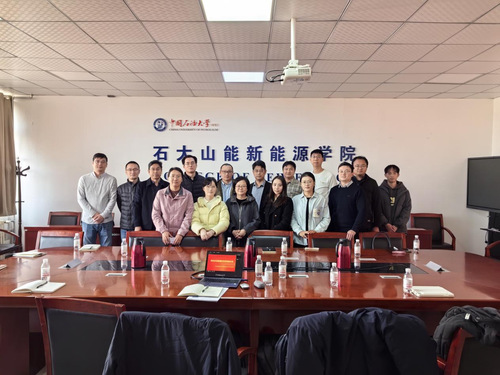
On December 9, 2025, the Department of Management Science of the School of Economics and Management (SEM) held a discussion meeting with the Department of Energy Storage Science and Engineering of the UPC–Shanneng New Energy Institute at Meeting Room 433, Comprehensive Laboratory Building. The meeting focused on interdisciplinary integration and featured in-depth exchanges on program development, research collaboration, talent cultivation, and Party building.
Representing SEM were Wang Hui, Party branch secretary of the Department of Management Science, Wang Ningning, department head, He Lihua, Director of the MEM Center, along with faculty and student representatives. Participants from the UPC–Shanneng New Energy Institute included Dai Pengcheng, Vice Dean, Kong Debin, department head of Energy Storage Science and Engineering, Li Liangjun, Party branch secretary, and other faculty representatives.
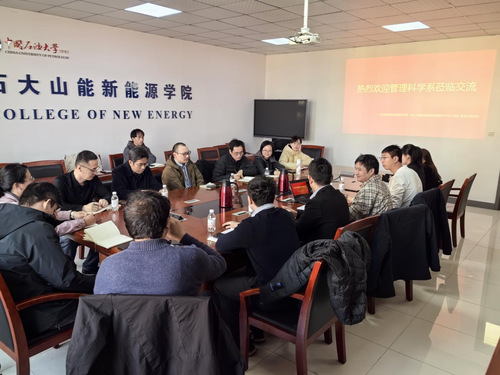
During the meeting, Dai Pengcheng discussed recent industry changes resulting from adjustments to the “mandatory energy storage allocation” policy. He noted that some energy storage projects have already experienced suspension or shutdown, and emphasized that—given that relevant technologies are increasingly available—greater attention should be placed on the role of economics, management, and energy policy research in providing systematic planning and institutional guidance for the development of the energy storage sector.
Li Liangjun introduced the Department of Energy Storage Science and Engineering, outlining its disciplinary background, research areas, team structure, and innovation outcomes. He highlighted the department’s research layout across materials, technologies, and engineering applications in the energy storage field. From an industry perspective, Kong Debin analyzed both opportunities and challenges facing the energy storage sector, including market potential, safety risks, and project costs. He pointed out that safety incidents and investment costs continue to significantly influence the adoption of user-side energy storage applications.
Wang Hui expressed appreciation for the support from the UPC–Shanneng New Energy Institute and the Department of Energy Storage Science and Engineering. He noted that the Department of Management Science, with its relatively strong social science orientation, can benefit from deeper engagement with engineering disciplines to expand interdisciplinary collaboration and achieve mutual reinforcement in both academic development and Party building.
Wang Ningning introduced the department’s four major research directions: energy-economic systems management and policy analysis; operations and supply chain management; data science and management; and engineering management and project management. He also shared recent progress in research output, faculty development, and graduate employment outcomes, while noting that enrollment scale remains a continuing pressure for the department.
In discussing talent cultivation and collaboration models, He Lihua proposed leveraging complementary strengths to explore pathways such as dual-degree programs, jointly developing practice-oriented teaching platforms, coordinating curriculum development, sharing internship and practice bases, and innovating joint training mechanisms to enhance the quality of interdisciplinary talent development in the energy–management domain. The two sides also exchanged views on potential collaboration in joint research project applications, research commercialization, and Party branch co-building initiatives.
The meeting further strengthened mutual understanding between the two departments and laid a solid foundation for advancing interdisciplinary integration, deepening research collaboration, and fostering innovative talent cultivation.