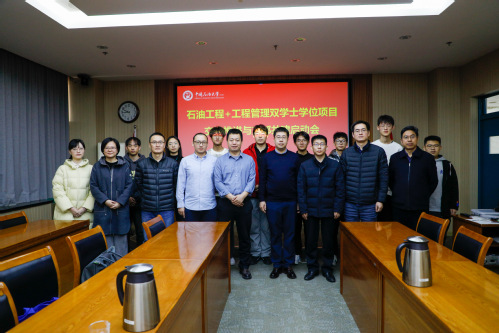
On December 9, 2025, the School of Economics and Management (SEM) and the School of Petroleum Engineering held a coordination meeting for the “Petroleum Engineering + Engineering Management” dual bachelor’s degree program and the launch ceremony of joint Party branch collaboration at Conference Room B347 of the Engineering Building. The meeting focused on advancing the dual-degree program, innovating interdisciplinary talent cultivation models, and exploring integrated education pathways that bridge engineering and management disciplines. The event also marked the formal launch of joint Party branch initiatives between the two schools.
The meeting was attended by Bai Yang, Vice Dean of SEM, Jia Han, Vice Dean of the School of Petroleum Engineering, Party branch secretaries and department heads from relevant programs, as well as faculty and student representatives from both schools.
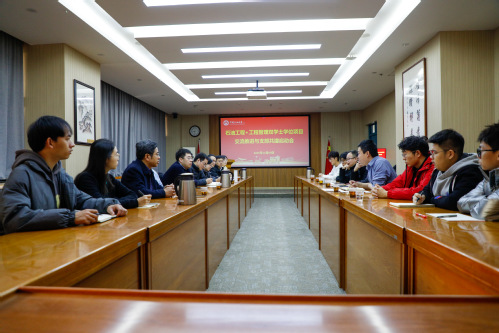
During the meeting, Jia Han introduced the overall undergraduate education framework of the School of Petroleum Engineering and shared expectations for the dual bachelor’s degree program. He emphasized that strengthening collaboration with SEM would help integrate the strengths of petroleum engineering and engineering management, guiding students to develop from “technically proficient” graduates into professionals who are both technically competent and capable of effective management.
Liu Yongwang, Professor from the Institute of Oil and Gas Well Engineering, provided an overview of the dual-degree program’s enrollment scale, credit structure, and operational progress. He noted that the program has attracted high-quality students and that the “one diploma, two degrees” model has expanded students’ options for postgraduate studies and career development, with overall implementation yielding positive outcomes.
Bai Yang introduced SEM’s recent developments, highlighting the School’s establishment of multiple provincial- and ministerial-level teaching and research platforms. He noted that this exchange provided an opportunity to learn from the School of Petroleum Engineering’s experience in national-level platform development and to further expand cooperation in talent cultivation and platform-based initiatives through the dual-degree program.
From the perspective of program development and graduate employment, Wang Hui, Party branch secretary of the Department of Management Science, analyzed the practical challenges currently facing the Engineering Management program given its relatively strong humanities orientation. He pointed out that the dual bachelor’s degree program offers a valuable reference and practical pathway for program transformation and for broadening students’ career trajectories.
During the discussion on curriculum design and training schemes, Wang Ningning, Head of the Department of Management Science, introduced the department’s faculty structure and curriculum system. He stated that the department would actively draw on the School of Petroleum Engineering’s mature experience in student training and program operation, and would continue to provide strong support for the dual-degree program from both talent cultivation and program development perspectives.
Yao Chuanjin, Head of the Department of Petroleum and Natural Gas Engineering, emphasized the importance of focusing on core competencies in dual-degree education. He suggested that courses relevant to postgraduate entrance examinations in management disciplines be systematically incorporated into the professional curriculum of the dual-degree program. Faculty members from both schools also engaged in in-depth discussions on specific issues, including management psychology courses, joint construction of internship and practice bases, and co-supervision of graduation theses.
Regarding Party branch collaboration, student Party member representatives shared their motivations for choosing the dual-degree program, noting that it enhances professional competitiveness while strengthening organizational coordination and communication skills, and broadening interdisciplinary perspectives across engineering and management fields. Faculty representatives from both schools proposed preliminary plans for joint activities, including class-level development programs, practical teaching initiatives, joint research, and collaborative internships. These efforts aim to promote synergy between “dual-degree development” and “Party branch collaboration” through joint thematic Party classes, shared practice projects, and co-cultivation of outstanding student leaders.
The meeting marked the transition of the Petroleum Engineering + Engineering Management dual bachelor’s degree program and joint Party branch collaboration into a systematic implementation phase. Moving forward, both schools will use this meeting as a starting point to further strengthen cooperation in curriculum optimization, resource sharing, practice platform development, and the deep integration of Party building with academic and educational activities, jointly exploring new pathways for cultivating high-caliber interdisciplinary talent at the intersection of engineering and management.