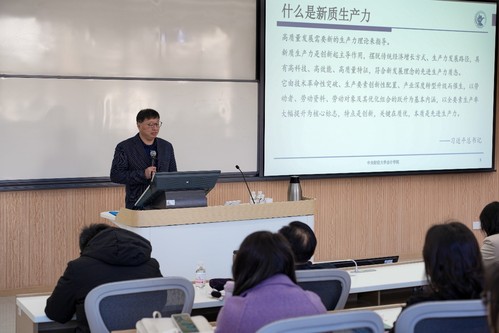
To advance the integration of new quality productive forces with management accounting practice and help faculty and students keep pace with emerging industry trends, Professor Liu Junyong (School of Accounting, Central University of Finance and Economics) was invited to deliver the 148th session of the Huangdao Business Lecture Series on December 3. His talk, titled “New Quality Productive Forces and the Development of Management Accounting,” was chaired by Deputy Dean Zhang Mingming. Faculty members and master’s and doctoral students attended the lecture.
In his presentation, Professor Liu systematically reviewed the policy context, core concepts, industrial scope, and implementation pathways of new quality productive forces, with a particular focus on the development directions of strategic emerging industries and future industries. He noted that fostering new quality productive forces requires targeted efforts in areas such as next-generation information technology, biotechnology, and new energy, and emphasized the role of disruptive and frontier technologies in reshaping the ecosystem of productive services. Against the backdrop of digital transformation, he further analyzed the transformation logic of management accounting: supported by digital and intelligent technologies, management accounting can achieve more precise resource allocation, deeper value creation, and continuous innovation empowerment through tool innovation, functional upgrading, and system redesign—shifting from back-end bookkeeping to front-end strategic enablement.
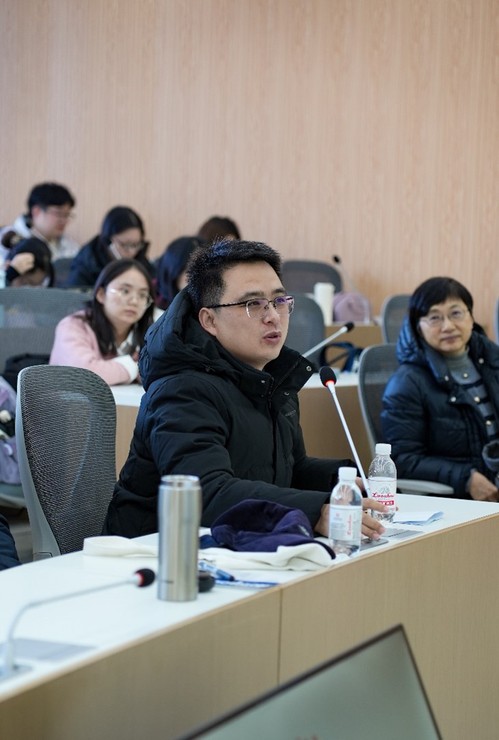
When discussing pathways for management accounting’s digital transformation, Professor Liu drew on practical cases from a Fortune Global 500 company, such as the use of hybrid AI to optimize rating processes and large models to mitigate capital risk. These examples illustrated the principle that technology empowers rather than replaces professionals, and demonstrated the effectiveness of digital-intelligent tools in management accounting scenarios. He emphasized that technological and business-model innovations driven by new quality productive forces require enterprises to continuously adjust strategy, strengthen business-finance data integration, redesign performance indicators, and enhance intelligent risk control to improve management accounting’s adaptability. During the Q&A session, Professor Liu engaged with faculty and students on topics including intelligent accounting applications, management accounting tool innovation, and action learning.
In closing remarks, Deputy Dean Zhang Mingming noted that the lecture offered a broad strategic perspective and rigorous analytical framework, clarifying how management accounting can redefine its knowledge boundaries and methodological approaches in the era of new quality productive forces. He added that the School will continue to develop high-level academic exchange platforms and encourage forward-looking research and practice at the intersection of new quality productive forces and management accounting.
About the Speaker
Professor Liu Junyong is a professor and doctoral supervisor at the School of Accounting, Central University of Finance and Economics, and Director of the China Management Accounting Research and Development Center. He serves as an advisory expert to the Ministry of Finance on management accounting and holds a number of academic and professional roles. His research focuses on strategy execution, management accounting, and action learning. He has published over 50 papers in leading journals and has led more than 20 research and consulting projects. He has also authored, translated, and edited multiple influential books and has received numerous awards for teaching cases and educational achievements.