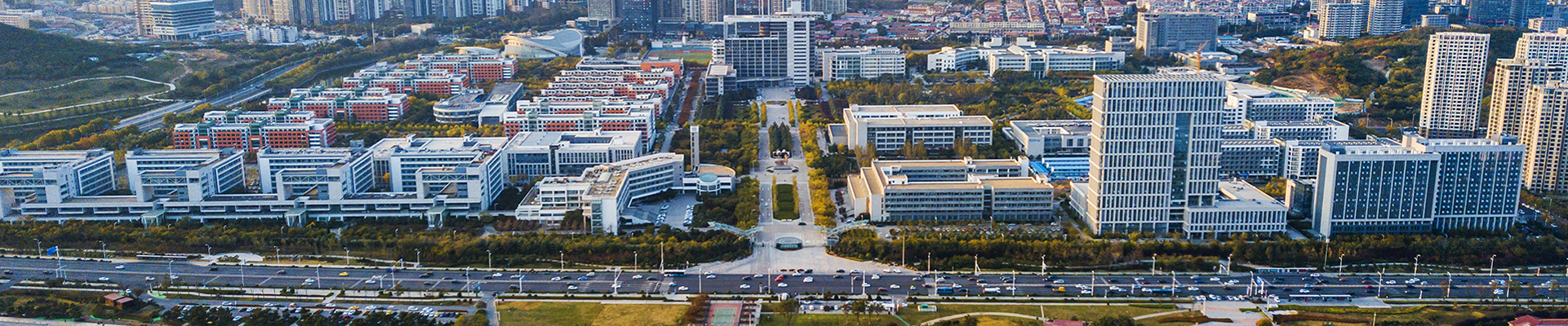
In recent years, the acceleration of the global energy transition and the steady advancement of China’s “dual-carbon” goals have created new opportunities for talent cultivation and scientific innovation in energy economics and management. Meanwhile, the new wave of scientific and technological revolution and industrial transformation—marked by rapid iteration in new energy technologies and the widespread application of digital-intelligent technologies—has posed new requirements for the development of New Liberal Arts talent.
Staying committed to the fundamental mission of moral education, the School practices its values of “Perseverance, Inquiry, Harmony, and Aspiration” (Hongyi, Gewu, Hehe, Zhiyuan). Through systematic efforts to advance disciplinary integration, integration of research and education, and industry–education integration, the School has preliminarily established a New Liberal Arts talent cultivation paradigm characterized by strong business foundations, distinctive energy-sector features, and a digital-intelligence edge.
Deepening “Business + Energy + Digital Intelligence” disciplinary integration to reshape a new system for Liberal Arts talent cultivation
Aligning proactively with national energy strategies and the digital-intelligent transformation needs of industries, the School has actively advanced the development of an interdisciplinary PhD track in energy economics and management, launched an undergraduate program in Big Data Management and Applications, and introduced micro-credential programs such as Carbon Neutrality and Energy Systems Management and Digital Marketing. The School has also expanded emerging directions including Intelligent Governance of Energy Transition Risks, Carbon Accounting, Energy Finance, and the Digital Economy. Leveraging the University’s disciplinary strengths in energy, the School has cultivated a cross-disciplinary, collaborative academic ecosystem.
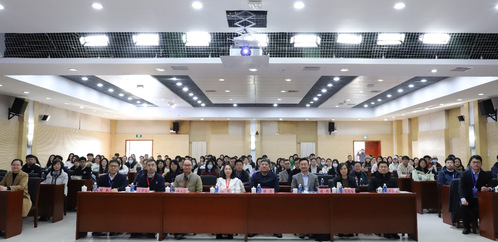
Professor Jian Ling, Deputy Dean (in charge of administrative affairs), emphasized that “disciplinary integration is not a simple addition, but a process of deep coupling enabled by mechanism innovation.” He noted that, guided by the School’s “Energy+,” “Digital Intelligence+,” and “Business+” development strategies, the School is implementing targeted initiatives such as building energy特色 talent-cultivation resources, developing a digital-intelligent course cluster, and forming cross-boundary teaching teams. These initiatives further strengthen a four-in-one talent cultivation system integrating values, knowledge, capabilities, and literacies, and continue to explore a New Liberal Arts paradigm distinctive to an energy-focused university.
Supported by this disciplinary roadmap, the School has advanced precise recruitment and development of talent. During the 14th Five-Year Plan period, the School has cultivated one recipient of a national high-level young talent program, introduced one Taishan Scholar Distinguished Professor and 12 Taishan Scholar Young Experts, and now has 18 faculty members recognized at or above the provincial/ministerial level. Nearly 50% of faculty have overseas experience of one year or more, and about 50% are under the age of 45—forming a dynamic faculty team with a balanced structure and strong international outlook.
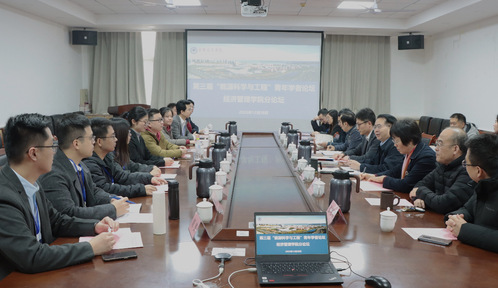
With this high-caliber faculty as a foundation, the School has carried out 13 national and provincial teaching reform projects, including “Exploration and Practice of Upgrading Management Programs in Industry-Featured Universities under New Liberal Arts.” These efforts have advanced an upgrade pathway characterized by “accreditation-driven improvement, integration-based empowerment, and digital-intelligent momentum,” and established the STREEM curriculum system—an interdisciplinary framework integrating sustainability, digital-intelligent technologies, responsible management, energy systems engineering, economic fundamentals, and management practice. Professor Liu Bingquan, head of the Shandong “Internet + Education” research base, noted that New Liberal Arts development should strengthen values-based guidance, promote the integration of next-generation information technologies with Liberal Arts disciplines, and innovate talent cultivation models.
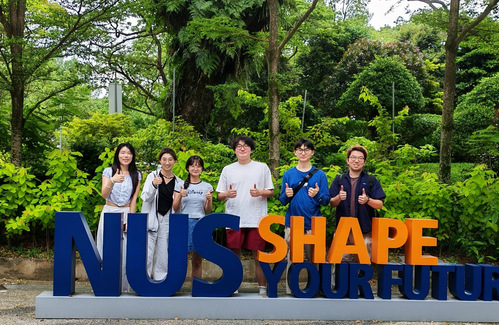
The School has also established interdisciplinary, international talent cultivation programs, supported by initiatives such as the “International Cooperative Talent Cultivation Program for Carbon Neutrality-Oriented Energy Transition Management Innovation” and the “China–Russia International Cooperation Program for Economic and Management Talent in Energy Digitalization.” Through partnerships with institutions including the National University of Singapore, the University of Alberta (Canada), and Lomonosov Moscow State University (Russia), the School sends more than 70 faculty and students abroad each year, enhancing students’ innovation capacity and global perspectives. The School’s talent cultivation capacity has also gained international recognition through breakthroughs in international business accreditation: the School achieved BGA Gold accreditation in 2022 and obtained eligibility for AACSB initial accreditation in 2023, moving steadily toward global standards in business education.
During the 14th Five-Year Plan period, all of the School’s programs have been selected as first-class undergraduate program construction sites, and the School has developed a strong portfolio of high-quality teaching resources, including national and provincial first-class courses, model courses for curriculum-based ideological and political education, first-class textbooks, and “Top 100” national teaching cases. The School has received three provincial-level teaching achievement awards, including the Shandong Higher Education Teaching Achievement Award. A cross-disciplinary, integrated talent cultivation system has taken shape, and its experience has been reported repeatedly by leading media outlets.
Promoting integrated development across faculty, undergraduate, and graduate education to form a new mechanism of research–education integration
The School adheres to the principle that high-level research should underpin high-quality teaching, integrating frontier research outputs and major research projects into curriculum design and classroom instruction.
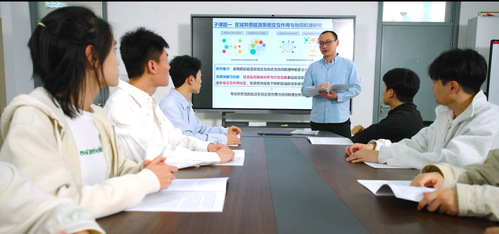
Professor Wang Hui, a recipient of a national high-level young talent program, observed: “Research is not only about publishing papers—it should feed back into teaching. Our research findings can be transformed directly into classroom cases, enabling students to engage with the most real and frontier scientific questions.” Since the start of the 14th Five-Year Plan period, faculty have led 40 projects funded by the National Natural Science Foundation of China and the National Social Science Fund of China (including four major/key projects), eight projects funded by the Ministry of Education (Humanities and Social Sciences), published 411 papers in high-level journals, and produced 13 academic monographs.
The School also leverages the “Huangdao Business Forum,” a high-level academic exchange platform hosted by the School, to invite renowned domestic and international experts for lectures, broaden academic horizons, and foster innovation. To date, 143 sessions have been held. Supported by national-level projects, the School has developed a range of featured courses integrating disciplinary frontiers and incorporated relevant research outcomes into courses such as Technology Economics, Energy Economics, and Big Data Analytics—continuously expanding students’ academic horizons and innovative thinking.
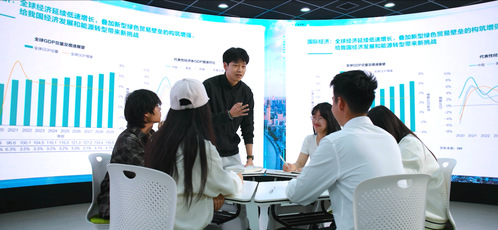
To cultivate “interdisciplinary, top-tier innovative talent” that meets the demands of the era, the School emphasizes the principle of “unity of knowledge and action,” shifting from “knowledge transmission” toward the shaping of capabilities and literacies. Professor Li Leiming, founding head teacher of the School’s “Zhixing Class,” noted in reflecting on the School’s talent cultivation pilots that deepening the integrated “faculty–undergraduate–graduate” mechanism and removing bottlenecks in research–education integration has become a key focus in recent years.
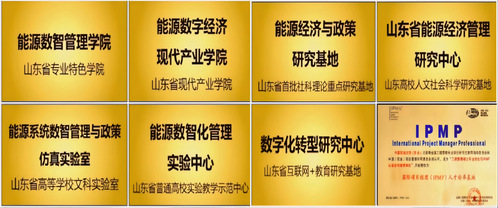
Relying on the first-level discipline of Management Science and Engineering, the School has formed an “Economics and Management Experimental Class” to promote integrated undergraduate–graduate cultivation. Innovation and entrepreneurship workstations co-built by faculty and students have been established across teaching units to support extracurricular innovation practice. The School continues to strengthen the educational function of research platforms through high-end bases such as the Shandong Energy Economics and Policy Research Base, the Liberal Arts Laboratory of Digital-Intelligent Energy Systems Management and Policy Simulation, and the Shandong Provincial Experimental Teaching Demonstration Center for “Energy Digital-Intelligent Management.” Five major modules have been prioritized—Intelligent Construction, Business Intelligence, Intelligent Accounting, Big Data Precision Marketing, and Simulation Sandtable—forming an integrated “data–software–hardware” experimental system that supports students to “enter labs early, join teams early, and engage in projects early.” Zhao Ruitong, a recipient of the University’s “Undergraduate Science and Technology Star” award, shared: “From classrooms to laboratories, projects, and research groups, the School’s research–education integration system has truly enabled us to apply what we learn.”
During the 14th Five-Year Plan period, the School’s students have repeatedly achieved new highs in competitions such as the “Challenge Cup” and innovation contests. In discipline-specific competitions, students won 324 national-level awards—four times that of the 13th Five-Year Plan period. Students also received a first prize in the Shandong Provincial Graduate Outstanding Achievement Award, a grand prize in the 10th National College Student Energy Economics Academic Creativity Competition, and achieved the University’s first award in the humanities and social sciences category at the 17th National College Student Innovation Annual Conference. The digital-intelligent level of student innovation outcomes has increased markedly, with high-level achievements such as a Top 11 finish in the global data science competition KDD Cup. Che Shuai and Gao Shuai were recognized as the University’s “Top Ten Academic Stars” among graduate students.
Strengthening multi-dimensional “University–Local Government–Enterprise” synergies to expand new pathways for industry–education integration
Industry–education integration is a key pathway for New Liberal Arts development and a necessary approach to connecting the education chain and talent chain with the industrial chain and innovation chain. In recent years, the School has expanded deep cooperation with leading enterprises in the energy sector and local governments, building a collaborative talent cultivation community featuring diversified synergies and shared resources.
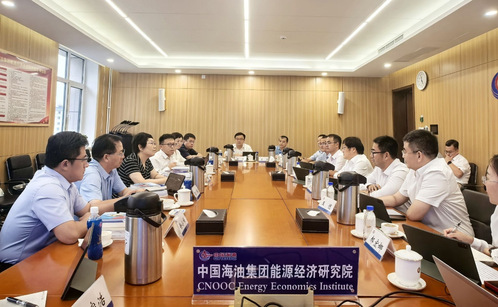
The School has co-established a National Demonstration Joint Training Practice Base for the MPAcc program with Shengli Oilfield, and a provincial/ministerial-level graduate joint training base with Sinopec Group Shared Services Co., Ltd. Leveraging platforms such as the Shandong Featured School “Energy Digital-Intelligent Management College” and the Shandong Modern Industry College for the “Energy Digital Economy,” the School integrates real enterprise management challenges and front-line cases throughout the talent cultivation process, creating industry-close learning scenarios and forming a multi-party win–win mechanism featuring co-built cultivation platforms, shared resources, and coordinated processes—strongly supporting the development of top-tier innovative talent in economics and management.
The School regularly invites entrepreneurs into core classrooms across majors, operates platforms such as “Huangdao Business Classroom” and the “Energy & Chemical Finance Training Program,” and hosts more than 30 high-level industry lectures annually. By introducing enterprise practice topics and transforming them into competition themes, and by implementing integrated “course + competition” training through a dual-mentor model (faculty and enterprise mentors), the School continuously enhances students’ practical and innovative capabilities.
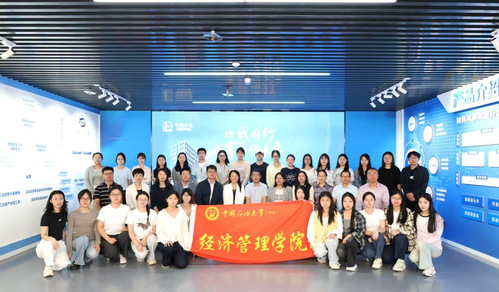
Supporting high-quality local development through industry–education integration is a core part of the School’s mission. During the 14th Five-Year Plan period, professors including Li Yongbo, Wang Aidong, Song Jiekun, and Hao Zengliang participated deeply in industrial support work for Horqin Left Back Banner (Inner Mongolia), completing 11 specialized plans covering new-type urbanization, services, integrated energy, grain industries, and strategic emerging industries, and further developing a “one county, one strategy” urbanization plan. Professor Zhang Xixi, Deputy Dean, led the development of the “Industrial and Science & Technology Innovation Development Plan for Horqin Left Back Banner during the 15th Five-Year Plan Period.” These outcomes provide a systematic, scientific pathway for high-quality development from multiple dimensions including industrial layout, energy structure, population policy, and industrial and technological development, reflecting a key practice of the School’s think tank strengths and integrated support through education and industry.
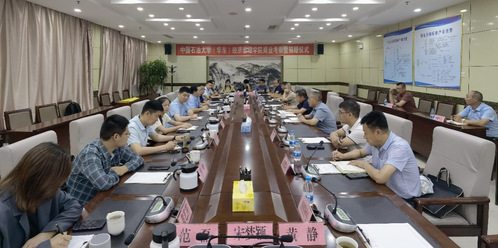
To respond to the new demands placed on business talent by the latest wave of technological and industrial transformation, the School is actively building a new industry–education integrated business education system. Guided by “business thinking, energy features, responsibility and sustainability, and technological innovation,” the School has innovatively developed the BEST curriculum system, integrating business knowledge, engineering technologies, scientific theories, and professional skills to comprehensively promote high-quality development of part-time business education. Professor Xu Xiaofeng noted: “Business education must break disciplinary and college boundaries and deeply integrate industrial technology frontiers and innovation trends to effectively serve the digital transformation of the energy industry and the major needs of regional economic upgrading.”
In terms of cultivation models, the School has promoted deep integration between teaching content and industry practice by offering “mobile classrooms in enterprises” and comprehensively implementing the “dual-mentor system.” Learning scenarios have been extended to industrial front lines. Zhang Yue, a 2024 MBA participant, reflected after an on-site learning module at Haier Group: “The enterprise-based learning experience took my understanding of supply chain finance beyond textbooks and truly connected theory with practice.”
Graduate outcomes are a key indicator of talent cultivation effectiveness. The School’s undergraduate progression-to-higher-study rate has exceeded 40%, and graduate employment has approached the “1234” structure (10% further study, 20% Party and government institutions, 30% leading private enterprises, and 40% central and state-owned enterprises). Graduates have performed strongly in sectors such as energy, finance, and consulting. Wang Yi, Party Secretary of Sinopec Tenth Construction Co., Ltd., commented: “Students from the School have both strategic thinking to grasp macro policies and a solid understanding of concrete business operations—this is exactly the kind of interdisciplinary talent we need.”
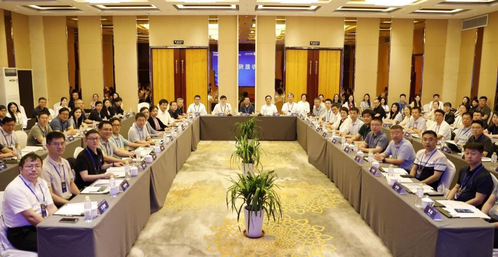
Looking ahead, the School will respond to the question of the times—“In the national endeavor of building a strong country, what should the School contribute?”—and strive to build a first-class school of economics and management rooted in China and deeply committed to the energy sector.
At the all-faculty meeting and the 15th Five-Year Plan planning workshop, Party Secretary Zhu Hua noted that the School will fully seize the opportunities brought by the University’s “2341” strategy and the integrated reform of education, science and technology, and talent development. Anchored in its strategic goals, the School will continue to deepen “integration for high quality,” strengthen organized approaches to teaching, research, and domestic and international collaboration, and provide precise support for talent development at all levels. The School will further refine the “Three Integrations” (disciplinary integration, research–education integration, and industry–education integration) and build a new talent cultivation ecosystem driven by “Four Synergies” (inter-school synergy, university–enterprise synergy, university–local government synergy, and international synergy), cultivating a new generation of economics and management talent with patriotism, global vision, innovative thinking, and strong practical capabilities.