To advance national initiatives on integrating industry and education and to strengthen higher education’s contribution to regional economic and social development, the School’s Deputy Dean (in charge of administrative affairs), Professor Jian Ling, attended the unveiling ceremony on November 29 for the Industry–Academia–Research Practice and Training Base jointly established by the School and Qingdao Zhongke Defense Technology Co., Ltd. The event was also attended by Mr. Gao Yong, Deputy Director of the Administrative Committee of Qingdao Economic and Technological Development Zone; Mr. Fu Taosheng, former Deputy Director of the Center for Coordinated Economic and National Defense Development under the National Development and Reform Commission; Mr. Dong Zhiyi, former Deputy Administrator of the Civil Aviation Administration of China; Mr. Gai Qiqing, Chief Economist of State Power Investment Corporation; and Mr. Hu Min, Deputy General Manager of the iFLYTEK Industrial Acceleration Center, among others.
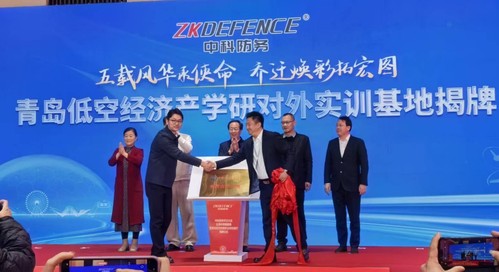
The training base aims to foster in-depth industry–academia–research collaboration with Qingdao Zhongke Defense Technology Co., Ltd., focusing on research topics such as the low-altitude economy, low-altitude security and safeguarding, and low-altitude data management. Once operational, the base will support undergraduate cognitive internships and professional internships, as well as postgraduate professional practice. It will implement a dual-mentor system and project-based learning, enabling students to better understand industry development and participate deeply in real enterprise projects. Through hands-on problem solving, students will strengthen their industry awareness, data analytics capabilities, and strategic decision-making skills. The School will also develop industry-integrated courses and teaching cases based on the base to better align curriculum content with industry needs.
Qingdao Zhongke Defense Technology Co., Ltd. is a high-tech enterprise dedicated to addressing civil drone monitoring, identification, and defense through information security technologies. The School has long prioritized platform building to empower talent development through industry–education integration. By working with industry partners, local governments, and research institutes, the School has established a series of practice and training bases in areas such as the low-carbon economy, energy security, the digital economy, the low-altitude economy, smart supply chains, green finance, and port logistics—forming an integrated ecosystem that supports talent cultivation, scientific research, and social service.